Label colour isn't just about looks — on an Australian switchboard, the colour of each label communicates purpose at a glance. Emergency, danger, warning, information — each has a colour convention, and getting them right makes a board easier to read under pressure and easier to inspect.
This guide covers the standard label colour combinations used in Australian switchboards, what each one signals, and how AS/NZS standards and workplace safety regulations shape the choice.
Why Label Colour Matters
In an emergency, nobody is reading fine print. The dominant visual cue on a switchboard is colour — and a consistent colour scheme means someone walking up to a board can instantly pick out the main switch, spot danger warnings, and identify emergency circuits without having to read every label.
Label colour conventions come from a combination of sources:
- AS 1319 — Safety signs for the occupational environment — Sets the colour coding for warning, danger, and information signs.
- AS/NZS 3000 (Wiring Rules) — Specifies labelling requirements, including legibility and durability, and references AS 1319 for warning label colours.
- Industry convention — Common practice for identification labels (white text on black for general circuits, for example) isn't always mandated, but inspectors and electricians expect it.
These combinations are available as engraved traffolyte — see the switchboard label range, or choose your colours in the designer and watch the price update as you go.
Standard Label Colour Conventions
General Circuit Identification — White on Black
The default for circuit identification labels is white text on a black background. This is the neutral, workhorse colour for identifying lights, GPOs, equipment, and any standard circuit. It is high contrast, reads well under poor lighting, and is the most universally accepted option.
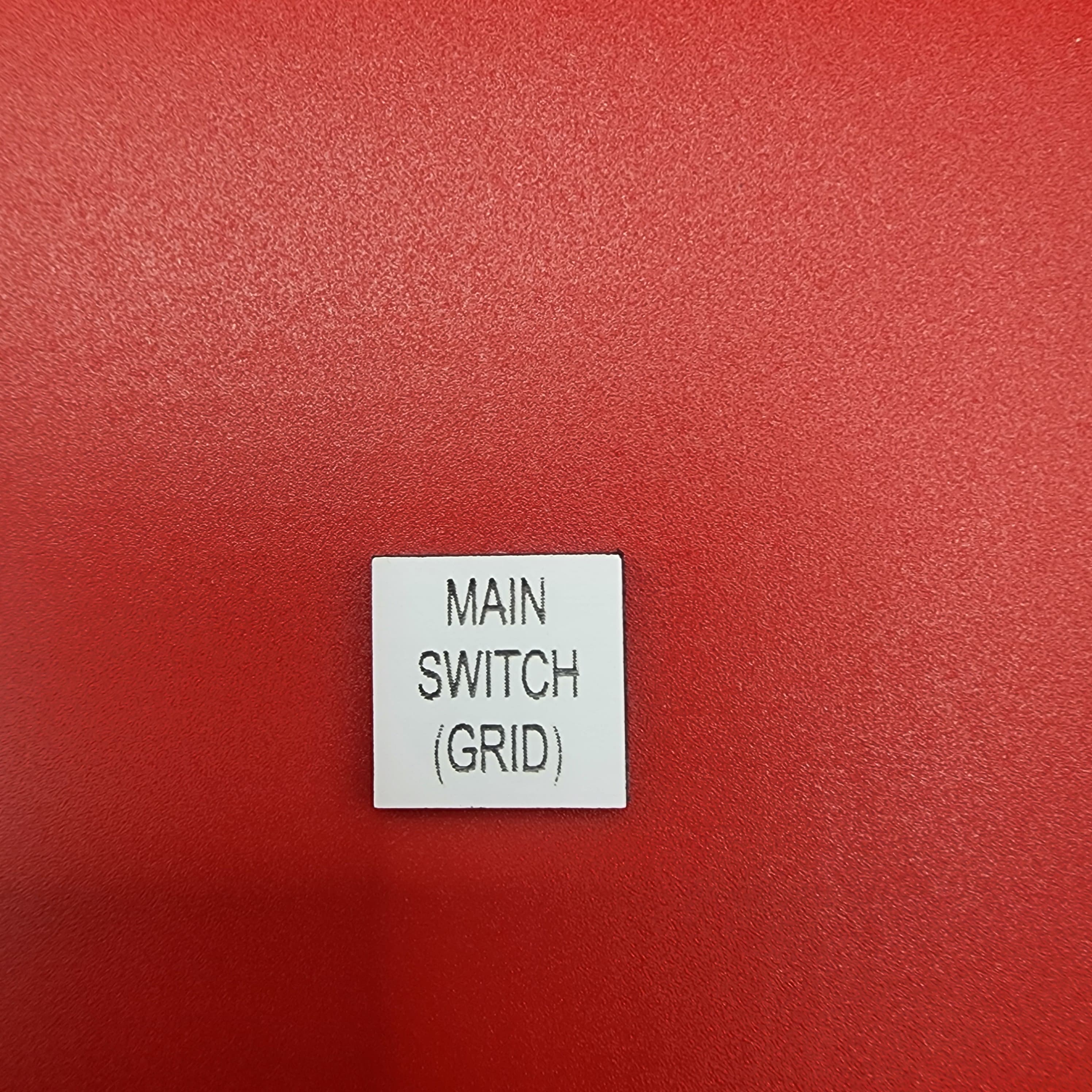
Danger — White on Red
Red is the danger colour. White text on red is used for:
- "DANGER — HIGH VOLTAGE" warnings
- "DANGER — DO NOT OPERATE" lockout labels
- Emergency stop identification
- Any label where the consequence of ignoring it is injury or death
Warning — Black on Yellow
Yellow with black text is the warning colour — used where there is a hazard but it is not immediately dangerous. Typical uses:
- "WARNING — MULTIPLE SUPPLIES"
- "WARNING — ISOLATE BEFORE WORK"
- "CAUTION — ALARM CIRCUIT"
- Solar PV warnings where DC is present
Safety and Emergency — White on Green
Green indicates safety — the correct or safe action. On switchboards this is less common but you will see it for:
- Emergency lighting circuit identification
- First aid or safety equipment circuits
- "NORMAL" position indicators on transfer switches
Information — White on Blue
Blue is the information or mandatory action colour. Used for:
- "WEAR PPE" notices
- Isolation procedure labels
- Maintenance information
Essential Services — White on Orange
Orange is often used in commercial and industrial installations for essential services — circuits that must remain operational even when the main supply is isolated, or that run from standby power.
Colour Combination Reference Table
| Background | Text | Meaning | Typical Use |
|---|---|---|---|
| Black | White | General identification | Circuit names, GPOs, lighting, equipment |
| Red | White | Danger | High voltage, emergency stop, lockout |
| Yellow | Black | Warning | Multiple supplies, solar PV, hazards |
| Green | White | Safety / Normal | Emergency lighting, safety circuits |
| Blue | White | Information / Mandatory | Procedures, PPE, instructions |
| Orange | White | Essential services | Standby, UPS-backed, critical circuits |
Common Colour Mistakes
Using Red for General Identification
Red should be reserved for danger warnings. Using red labels for regular circuit identification dilutes the warning meaning — when everything is red, nothing stands out as dangerous.
Low-Contrast Combinations
Black text on dark red, white text on yellow, or any combination that does not have strong contrast fails the legibility requirement. Stick to high-contrast pairings.
Inconsistent Use Across a Board
Mixing colour schemes within a single switchboard (some circuits white-on-black, others yellow, others blue) makes the board harder to read. Pick a convention and apply it consistently.
Colour-Only Information
Colour is a secondary cue — never the only one. Colour-blind workers should still be able to read the label content. Always pair colour with clear text.
Matching Your Label Colours to the Installation
For most Australian residential and light commercial work, the minimum viable scheme is:
- White on black for all circuit identification
- White on red for danger warnings (high voltage, main switch)
- Black on yellow for multiple supplies and warnings
For commercial, industrial, or solar installations, add:
- White on orange for essential / standby circuits
- White on blue for isolation and maintenance procedures
- White on green for emergency lighting or safety systems
Related Guides
- Switchboard Labelling Requirements in Australia: AS/NZS 3000 Explained
- How to Label a Switchboard: Practical Guide for Australian Sparkies
- Main Switch & Isolator Labels: Australian Requirements
Ordering Colour-Coded Labels
Our Label Designer supports all common traffolyte colour combinations — white on black, white on red, black on yellow, white on green, white on blue, and white on orange. Preview the colour contrast before you order, and get instant pricing on any size. For bulk orders and trade pricing, see our plans or get in touch.
Pick your colours and order: every combination in this guide is available in our traffolyte label range and the switchboard label designer — priced live as you type.