
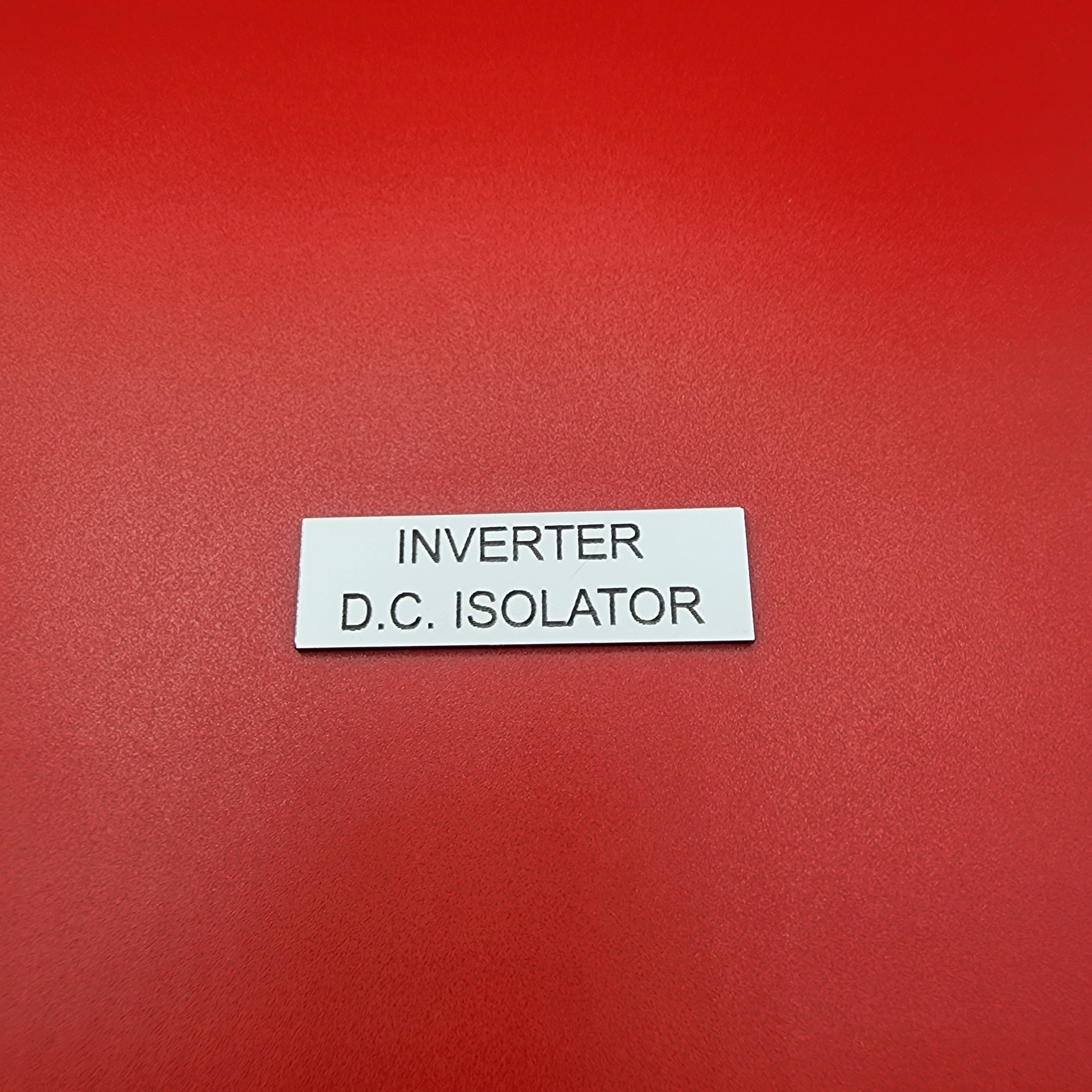
When you need permanent markings on a material — whether it's a label, a nameplate, or a decorative piece — two methods dominate: laser engraving and rotary engraving. Both produce durable results, but they use fundamentally different processes and each has distinct advantages. Understanding the differences helps you choose the right method for your project.
How Laser Engraving Works
Laser engraving uses a focused beam of light (typically a CO2 or fibre laser) to vaporise or ablate the surface of a material. The laser head moves across the workpiece at high speed, removing material wherever it fires. The depth and darkness of the mark is controlled by adjusting the laser power, speed, and number of passes.
Because there's no physical contact between the tool and the workpiece, laser engraving is extremely precise and can reproduce fine detail — including small text, logos, barcodes, and photographic images.
Key characteristics:
- Non-contact process — no tool wear, no clamping forces
- Very high precision — can engrave text as small as 1mm
- Fast for flat work — especially efficient for batch production
- Software-driven — design changes are instant, no tooling changes
- Minimal setup time — go from design file to finished piece in minutes
How Rotary Engraving Works
Rotary engraving uses a small spinning cutter (similar to a CNC router) to physically carve into the material. The cutter removes chips of material as it follows the programmed path, creating grooves that form the text or design. Different cutter profiles produce different line widths and depths.
Rotary engraving has been the industry standard for decades, particularly for traffolyte labels, nameplates, and signage. The engraved grooves can be filled with paint for colour contrast.
Key characteristics:
- Physical cutting — produces a tactile, recessed mark
- Deep engraving possible — can cut through multiple layers (e.g., traffolyte)
- Proven durability — cut grooves last indefinitely
- Works on thick materials — handles substrates that lasers can't penetrate
- Paint-fill capability — colour-filled engravings for high contrast
Material Compatibility
Laser Engraving
CO2 lasers work well on:
- Acrylic and plastics (including traffolyte/laminate)
- Wood and MDF
- Leather
- Glass (surface marking)
- Coated metals (e.g., anodised aluminium — the laser removes the coating)
- Paper and cardboard
Fibre lasers extend this to bare metals (stainless steel, brass, titanium) and are used for deep metal marking in industrial applications.
Rotary Engraving
Rotary engraving works on:
- Traffolyte (multi-layered engraving laminate) — the classic application
- Aluminium and brass
- Stainless steel
- Hard plastics (Perspex, Delrin, nylon)
- Wood (though laser is usually preferred)
When to Use Laser Engraving
Laser is generally the better choice when you need:
- Fine detail — small text, intricate logos, barcodes, QR codes
- Speed on flat stock — laser is faster for batch production of labels and plates
- Photographic or raster images — laser can reproduce photos, gradients, and complex graphics
- No-contact processing — delicate or thin materials that can't withstand cutting forces
- Quick turnaround — minimal setup, design changes are instant
- Curved surfaces — with a rotary attachment, lasers can engrave cylindrical objects
When to Use Rotary Engraving
Rotary engraving is the better choice when you need:
- Deep cuts — cutting through multiple layers of laminate (classic traffolyte labels)
- Tactile markings — Braille, raised lettering, or marks that need to be felt
- Paint-filled text — engraved grooves can be filled with contrasting paint colours
- Very thick substrates — materials too thick for a laser to cut through
- Certain compliance requirements — some industries specify rotary-engraved labels for durability standards
Traffolyte Labels: Laser or Rotary?
Traffolyte (also called engraving laminate) is a multi-layered plastic sheet where the top layer is one colour and the core is another. The traditional method is rotary engraving, which cuts through the top layer to reveal the contrasting colour beneath.
However, modern CO2 lasers can also engrave traffolyte with excellent results — often faster and with finer detail than rotary. The laser vaporises the top layer cleanly, producing crisp, high-contrast text. For most traffolyte label applications today, laser engraving is the preferred method due to its speed, precision, and ability to handle complex designs.
At RBZ 3D, we use laser engraving for our electrical and industrial labels. This allows us to offer fast turnaround, precise detail, and the ability to handle everything from simple switchboard labels to complex multi-colour designs through our online label designer.
Cost Comparison
For small to medium runs, laser engraving is typically more cost-effective because:
- No tooling costs (rotary cutters wear and need replacing)
- Faster setup (no cutter changes, no fixturing)
- Higher throughput on flat stock
For very high-volume production of simple text-only labels, rotary engraving can be competitive — especially when dedicated multi-spindle machines are used. But for most applications, laser wins on both cost and flexibility.
The Bottom Line
Both methods produce permanent, professional results. Laser engraving is the modern standard for most applications — faster, more precise, and more versatile. Rotary engraving still has its place for deep-cut work, tactile markings, and specific industry requirements. When in doubt, laser is usually the right call.
Need labels or engraved plates? Check out our label ordering options or design your own label online.