
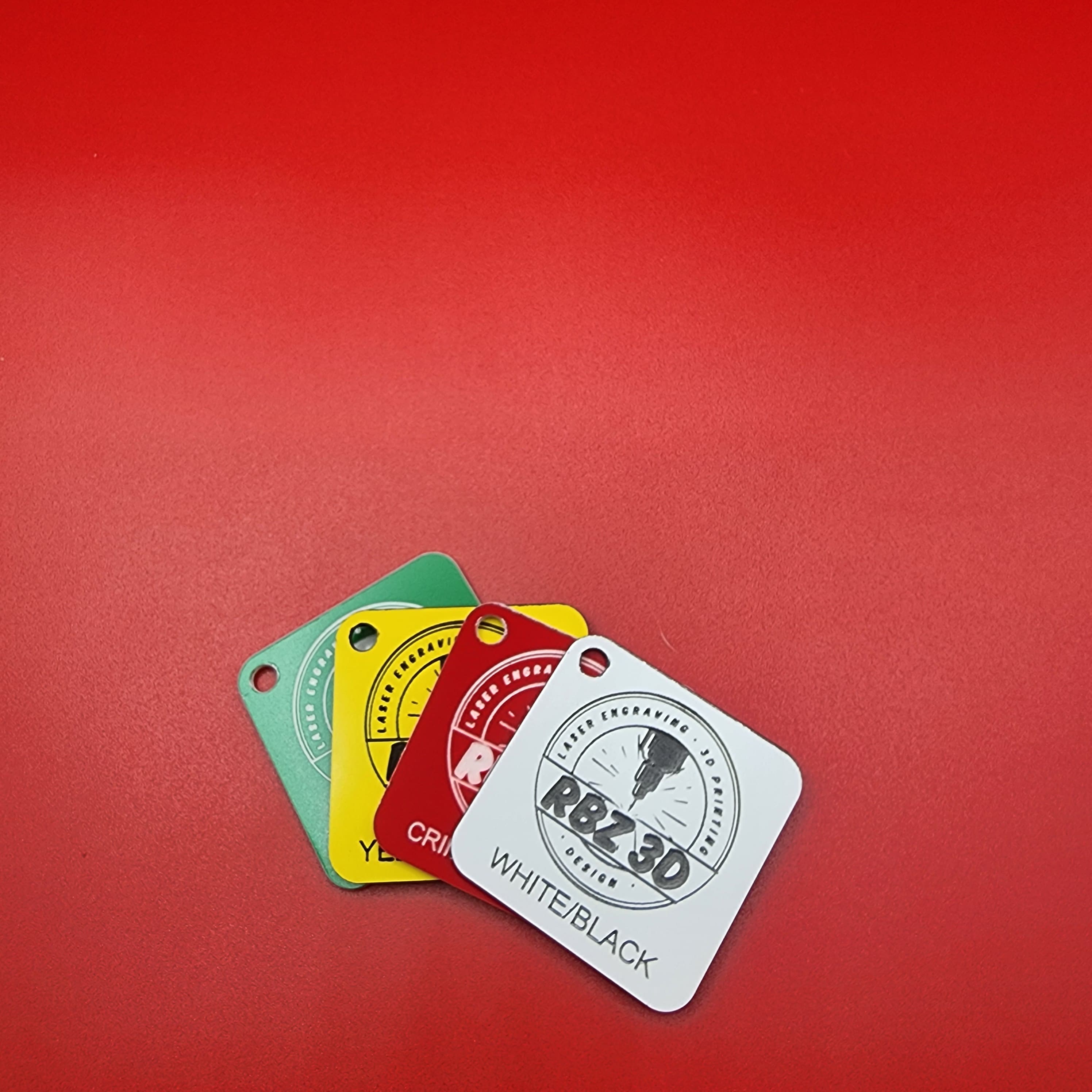
Traffolyte is a multi-layered engraving laminate used to create professional labels, tags, and signage. When the top layer is engraved or laser-cut, the contrasting colour underneath is revealed, producing crisp, permanent text and graphics. It's been the industry standard for engraved labels in Australia for decades — and for good reason.
If you've ever seen a label on a switchboard, a safety sign in a plant room, or a nameplate on a piece of equipment, there's a good chance it was made from traffolyte. This guide covers what traffolyte is, how it's made, what it's used for, and why it remains the go-to material for professional labelling.
How Traffolyte Is Made
Traffolyte is a thermoset or thermoplastic laminate consisting of two or more thin layers of different coloured material bonded together under heat and pressure. The most common construction is:
- Top layer (cap) — The visible colour you see on the surface. Typically 0.1–0.3mm thick.
- Core layer — The contrasting colour that's revealed when the top layer is engraved. This makes up the bulk of the sheet thickness.
Some traffolyte products have three or more layers, allowing for multi-depth engraving effects — though two-layer is by far the most common for standard labels.
The base material is usually either modified acrylic or phenolic resin. Modified acrylic is the most common today: it machines cleanly, engraves well with both rotary and laser methods, and is available in the widest colour range.
Colour Combinations
One of traffolyte's biggest advantages is the huge range of colour combinations available. Some of the most popular for Australian electrical and industrial work include:
| Surface Colour | Engraved Colour | Common Use |
|---|---|---|
| Black | White | General purpose, switchboard labels |
| Red | White | Emergency circuits, fire services, danger signs |
| Blue | White | Information signs, compressed air systems |
| Yellow | Black | Caution signs, gas systems, high-visibility labels |
| Green | White | Safety signs, first aid, water systems |
| White | Black | Nameplates, office signage, clean rooms |
| Orange | Black | Warning signs, machinery labels |
| Grey | White | Subtle signage, architectural applications |
The colour choice isn't just aesthetic — in many cases, Australian Standards and workplace safety regulations dictate specific colours for specific purposes. For example, red labels are expected on emergency or fire-related circuits, and yellow is used for caution and gas identification.
How Traffolyte Is Engraved
There are two main methods for engraving traffolyte:
Laser Engraving
A CO2 or fibre laser vaporises the top layer to reveal the contrasting colour beneath. This is the method we use at RBZ 3D. Advantages include:
- Fine detail — Laser engraving can reproduce very small text (down to about 2mm height), intricate logos, and detailed safety symbols.
- Speed — Lasers are significantly faster than rotary methods, especially for complex designs or large batches.
- No tool wear — Unlike rotary bits, a laser beam doesn't dull or break, so quality is consistent from the first label to the thousandth.
- Clean edges — Laser engraving produces sharp, clean lines without burrs or rough edges.
- Cutting — The same laser can cut the labels to exact dimensions and add mounting holes, all in one operation.
Rotary Engraving
A spinning cutting bit physically removes the top layer. This is the traditional method and is still used in some workshops. It produces a slightly different look — the engraved channels tend to be wider and deeper — and is better suited for very thick materials or applications where a tactile (raised or recessed) finish is desired.
Traffolyte Properties
What makes traffolyte such a good label material? Here are the key properties:
- Permanence — The engraved text is physically carved into the material, not printed on top. It cannot fade, peel, or rub off. A traffolyte label will remain legible for decades.
- UV resistance — Quality traffolyte resists yellowing and colour fading from UV exposure, making it suitable for outdoor use.
- Chemical resistance — Resistant to most common chemicals, solvents, and cleaning agents encountered in industrial environments.
- Temperature tolerance — Withstands temperatures from well below freezing to around 80–100°C (depending on the specific formulation). This covers most industrial environments, including switchboards that may generate heat under load.
- Electrical insulation — Traffolyte is a non-conductive material, which is particularly important for labels used inside switchboards and on electrical equipment.
- Self-extinguishing — Most traffolyte products are self-extinguishing (they stop burning when the flame source is removed), which is relevant for electrical applications.
- Machinability — Cuts and engraves cleanly without chipping, splintering, or melting excessively.
Common Applications
Traffolyte is used across a wide range of industries and applications in Australia:
Electrical
- Switchboard circuit labels
- Main switch identification
- Warning labels (multiple supplies, high voltage)
- Cable tags
- RCD test reminder labels
Industrial
- Valve tags and pipe identification
- Equipment nameplates
- Control panel labels
- Safety signage
- Asset tags
Commercial
- Door signs and room identification
- Desk nameplates
- Wayfinding signage
- Braille and tactile signage (using multi-layer traffolyte)
Compliance
- AS/NZS 3000 switchboard labels
- WHS safety signage
- Fire panel and emergency labels
- Plant and equipment identification
Traffolyte Thickness
Standard traffolyte comes in several thicknesses:
- 0.5mm — Thin and flexible. Good for labels that need to conform to curved surfaces or fit in tight spaces.
- 0.8mm — A popular general-purpose thickness. Rigid enough to stay flat but thin enough to sit neatly on a panel.
- 1.5mm — The standard for most switchboard and industrial labels. Provides good rigidity and a substantial feel.
- 3.0mm — Thick and rigid. Used for larger signs, standalone plaques, and applications where extra durability is needed.
How to Order Traffolyte Labels
At RBZ 3D, you can design custom traffolyte labels online using our Label Designer. Choose your colour combination, enter your dimensions, add your text and any cutouts, and get an instant price. No minimum order — we're happy to produce a single label or a batch of hundreds.
For bulk orders, our plans offer credits and discounts that reduce the per-label cost. For very large projects, get in touch for trade pricing.
We laser engrave and ship from Townsville, QLD, with delivery Australia-wide via tracked post. Most orders are produced within 1–3 business days.
Want it in your hands? Browse custom traffolyte labels and signs — every colour combination, any size or shape, designed online with instant pricing.
Wondering what traffolyte costs? See real per-label traffolyte label prices for common sizes — no quote needed — or compare every Australian supplier in our where to buy traffolyte labels guide.