Labelling a switchboard isn't complicated, but doing it well — in a way that passes inspection, stays legible for 20 years, and actually helps whoever has to work on the board — takes a bit of planning. This guide walks through the practical process from start to finish: planning, naming, sizing, material selection, and installation.
Step 1 — Plan Before You Design
Before you open a label designer, you need to know what you are labelling. For a new installation, work from the switchboard drawing and circuit schedule. For an existing board, do a live walkthrough and document every circuit.
What to Document for Each Circuit
- Circuit number (CB1, CB2, etc.)
- What it supplies (be specific — "GPOs — KITCHEN EAST WALL", not "KITCHEN")
- Breaker size and type (e.g., 20A RCBO)
- Any related notes (e.g., "shared neutral with CB4")
Document the main switch, any sub-main isolators, neutral and earth bars, RCDs, and any equipment with its own dedicated label (air con isolators, hot water, etc.).
Short on time? Steps 2 to 6 are already built into the switchboard label designer — choose a size, type your circuit list, and the price updates as you go. Or see switchboard label options and prices first.
Step 2 — Decide on a Naming Convention
Consistency is what separates a professional-looking board from a messy one. Pick a format and stick to it across every label.
Common Formats
- Number — Description — Rating: "CB1 — LIGHTS GROUND FLOOR — 16A"
- Description — Rating: "LIGHTS GROUND FLOOR — 16A"
- Number + Description only: "1. LIGHTS — GROUND FLOOR"
For residential, format 2 or 3 is usually fine. For commercial and industrial, include the circuit number and rating so the label matches the circuit schedule.
Naming Rules of Thumb
- All uppercase — easier to read at a glance
- Abbreviate consistently — "GPOs" not "PowerPoints", "A/C" not "AIR CON"
- Location before equipment — "KITCHEN A/C" not "A/C KITCHEN"
- Avoid vague terms — no "MISC", "OTHER", or "GENERAL" unless genuinely unknown
- Use the building's language — if the site calls it "Plant Room 2", your label says "PLANT ROOM 2", not "MECH ROOM B"
Step 3 — Size the Labels
Label dimensions depend on the switchboard type and the space available. Measure the existing label wells or the flat area above each breaker before designing.
Typical Sizes
| Application | Typical Size | Text Height |
|---|---|---|
| Circuit ID (small DIN) | 25mm × 8mm | 3–4mm |
| Circuit ID (standard) | 40mm × 12mm | 4–5mm |
| Circuit ID (large industrial) | 60mm × 20mm | 6–8mm |
| Main switch | 80mm × 25mm | 10–15mm |
| Warning labels | 100mm × 50mm or larger | 10–15mm |
| Isolation procedure | A5 or A4 | 8–12mm |
Rule of thumb: label text should be readable from 2 metres away at a normal glance.
Step 4 — Choose the Material
For AS/NZS 3000 compliance, the label needs to be permanent — engraved traffolyte is the Australian standard. Other materials have their place but have specific trade-offs.
- Traffolyte (engraved laminate) — First choice for switchboard labelling. Lasts 20+ years, UV and heat stable, available in every colour combination.
- Anodised aluminium — For harsh environments (outdoor, corrosive, high-temperature). More expensive than traffolyte.
- Stainless steel — For marine, food-processing, and other wash-down environments.
- Printed polycarbonate — Acceptable for indoor light-commercial if UV-rated.
- Dymo tape — Not acceptable for permanent installations.
Step 5 — Pick Colour Combinations
Use colour to reinforce meaning. For a detailed reference, see our switchboard label colours guide, but the basics:
- White on black — circuit identification (the default for most labels)
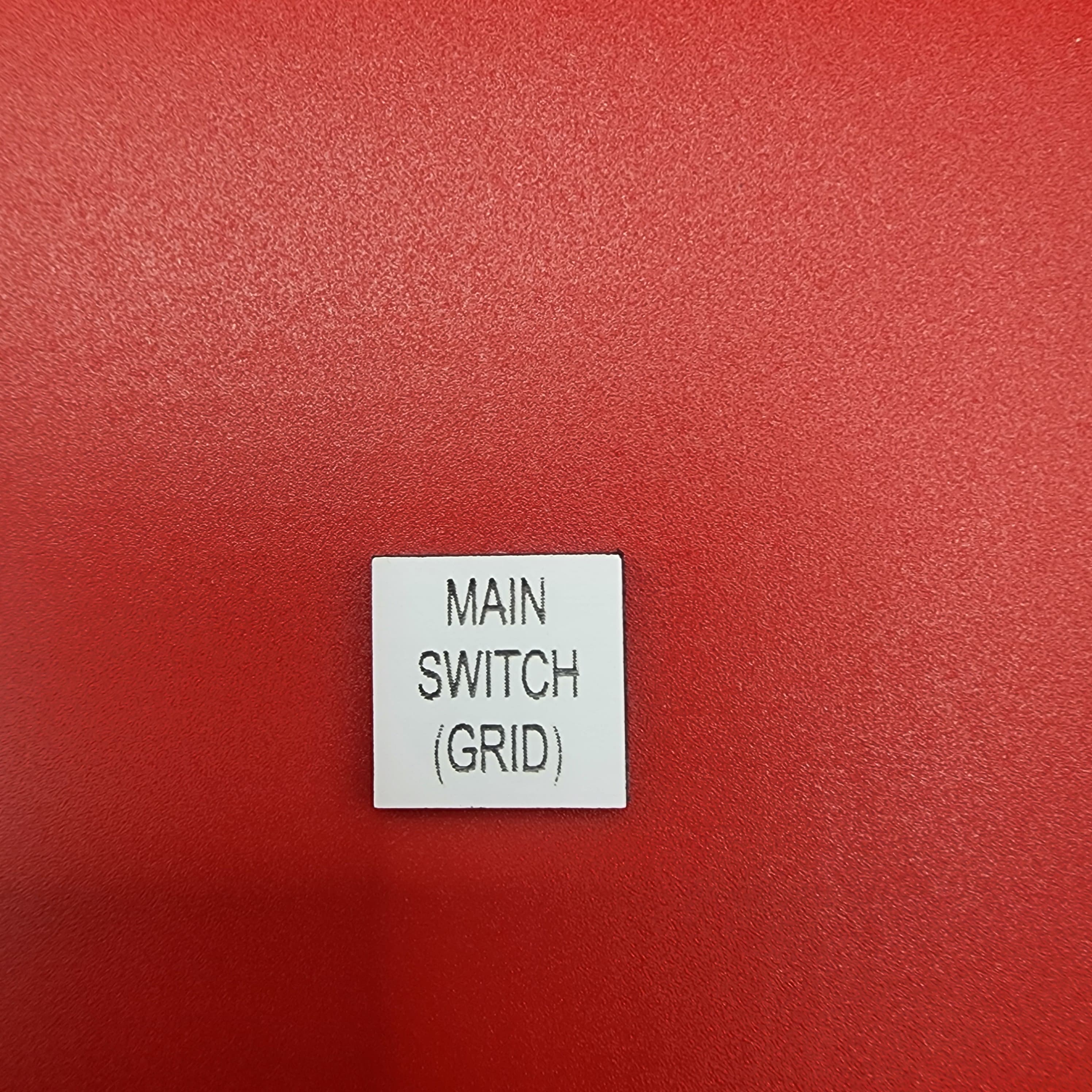
- White on red — main switch, danger warnings
- Black on yellow — multiple supplies, warnings, solar
- White on orange — essential services
- White on blue — isolation procedures, information
Step 6 — Design and Order
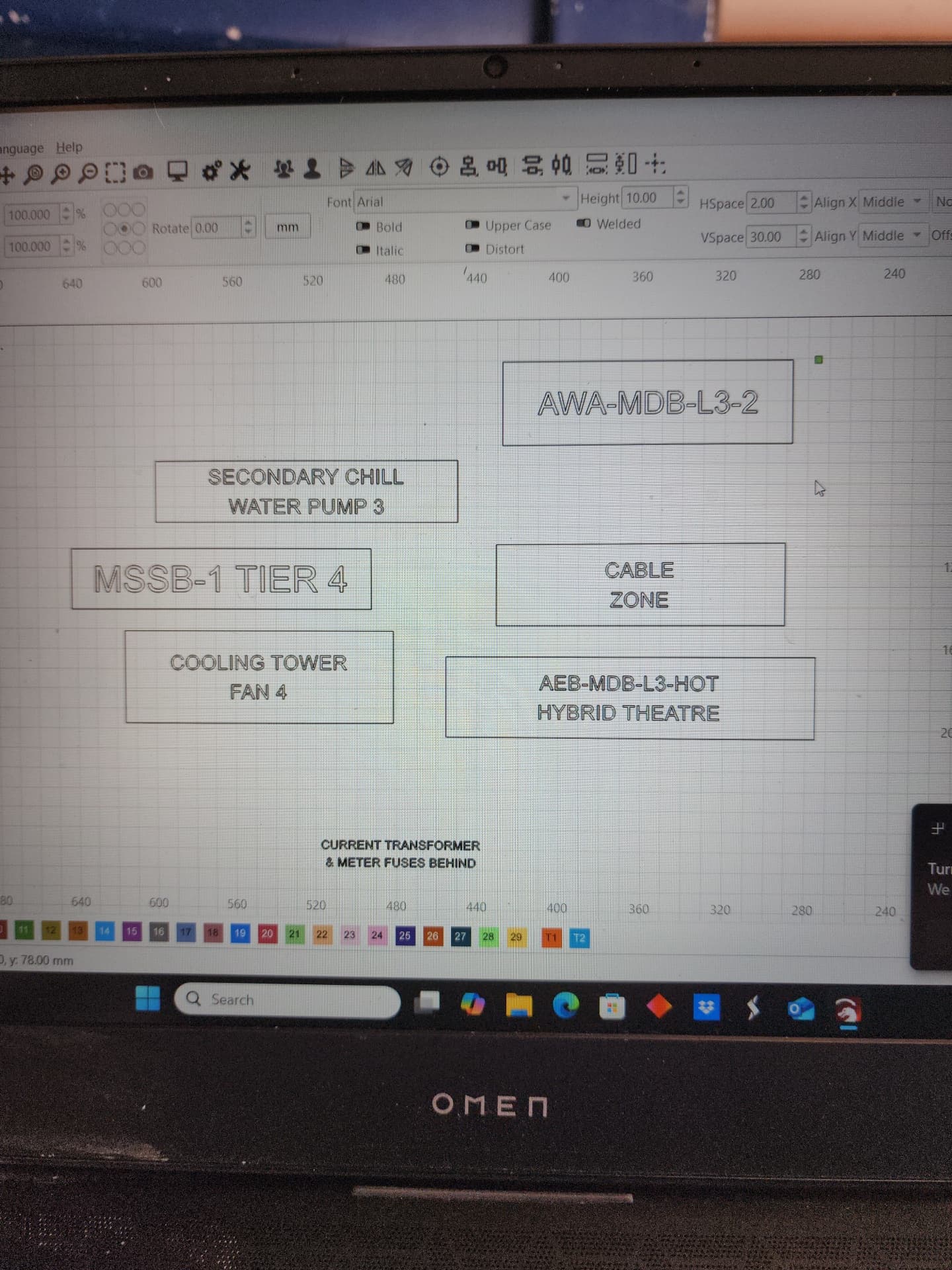
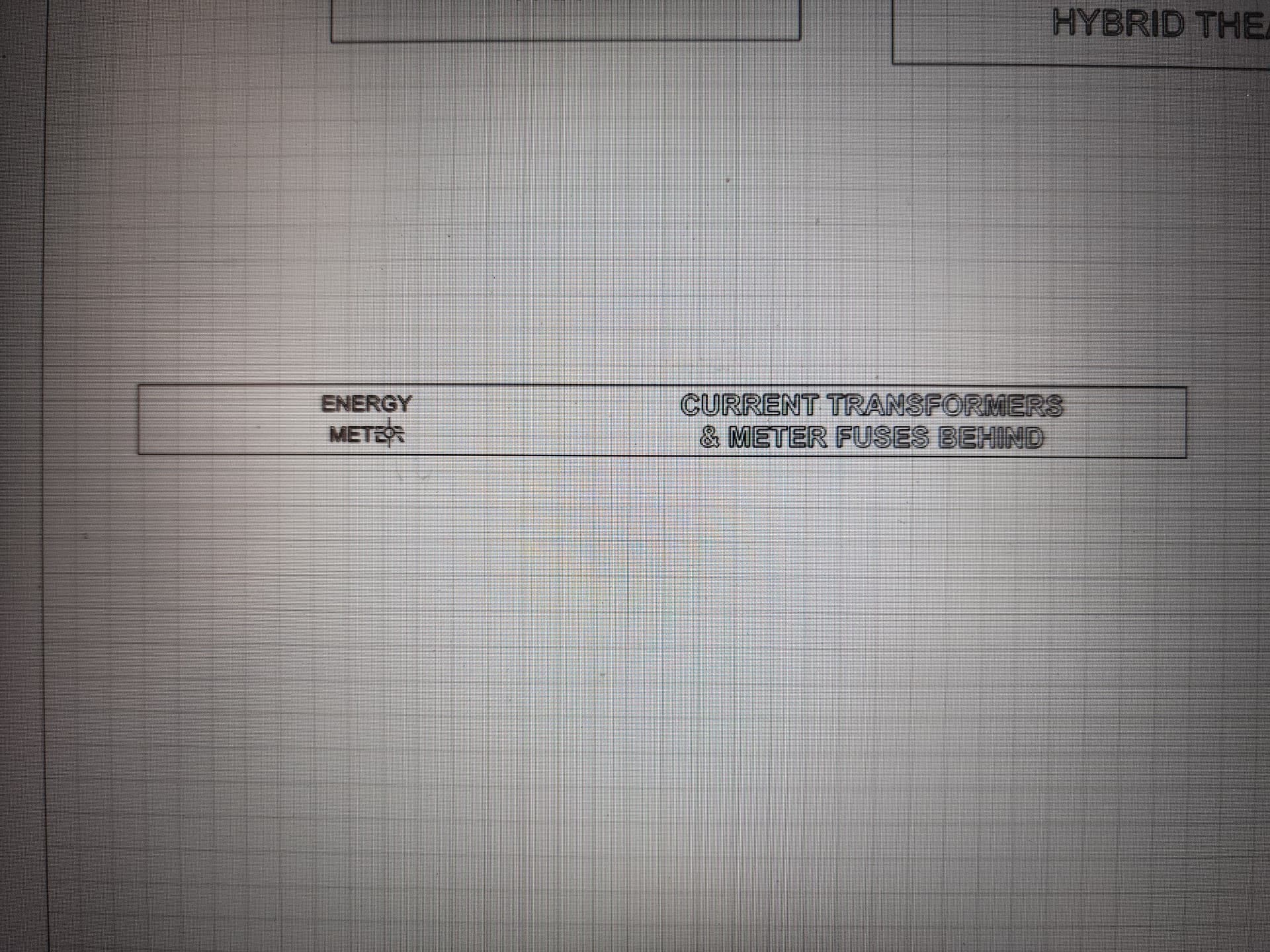
Lay out the full label schedule in a designer tool before you order — it is faster than designing each label separately, and you catch inconsistencies. Our online Label Designer lets you design multi-label sheets, preview colours, and get instant pricing.
Designer Tips
- Keep the font consistent across the whole board — one family, one size per label type
- Leave 2–3mm margin on each side of the text so it doesn't crowd the edge
- Check each label at actual print size before ordering
- Order 10% extra in common sizes — boards change, circuits get added
Step 7 — Install the Labels
Most switchboard labels are installed with double-sided adhesive tape or self-adhesive backing. Some boards have label wells or clips.
Installation Checklist
- Clean the surface first — isopropyl alcohol removes dust and oil. Adhesive fails on dirty surfaces.
- Align to the circuit, not the panel edge — labels should sit directly above the breaker they identify.
- Press firmly for 10 seconds — adhesive bonds need pressure to cure.
- Use the label well if provided — snap-in carriers are designed for standard traffolyte thicknesses.
- Don't install labels over ventilation slots — covering vents can cause heat build-up in older switchboards.
Step 8 — Update the Circuit Schedule
The physical labels and the circuit schedule (the list inside the switchboard door or in the site documentation) must match. If you have renumbered circuits or changed descriptions, update the schedule and any building management records before you leave site.
Relabelling Existing Boards
When relabelling an existing board, follow this sequence:
- Isolate the supply and verify dead where practical
- Photograph the existing labels for reference
- Carry out a live-circuit trace to verify each label is correct
- Document any discrepancies (label says "KITCHEN" but actually feeds bathroom)
- Design the new labels based on verified circuits
- Remove old labels completely (adhesive residue needs solvent)
- Install new labels
- Update the circuit schedule
- Hand the documentation to the building owner or facility manager
Related Guides
- Switchboard Labelling Requirements in Australia: AS/NZS 3000 Explained
- Switchboard Label Colours in Australia: AS/NZS Standards Explained
- RCD Test Labels & Labelling Requirements in Australia
- Main Switch & Isolator Labels: Australian Requirements
Ordering Your Switchboard Labels
Use our online Label Designer for one-off jobs, or contact us for a quote on a full switchboard labelling project. Traffolyte labels are usually produced within 1–3 business days and shipped Australia-wide.
Doing the board this week? Design the full set of engraved switchboard labels online — circuit IDs, main switch and warning labels priced instantly, engraved in 1–3 business days.