
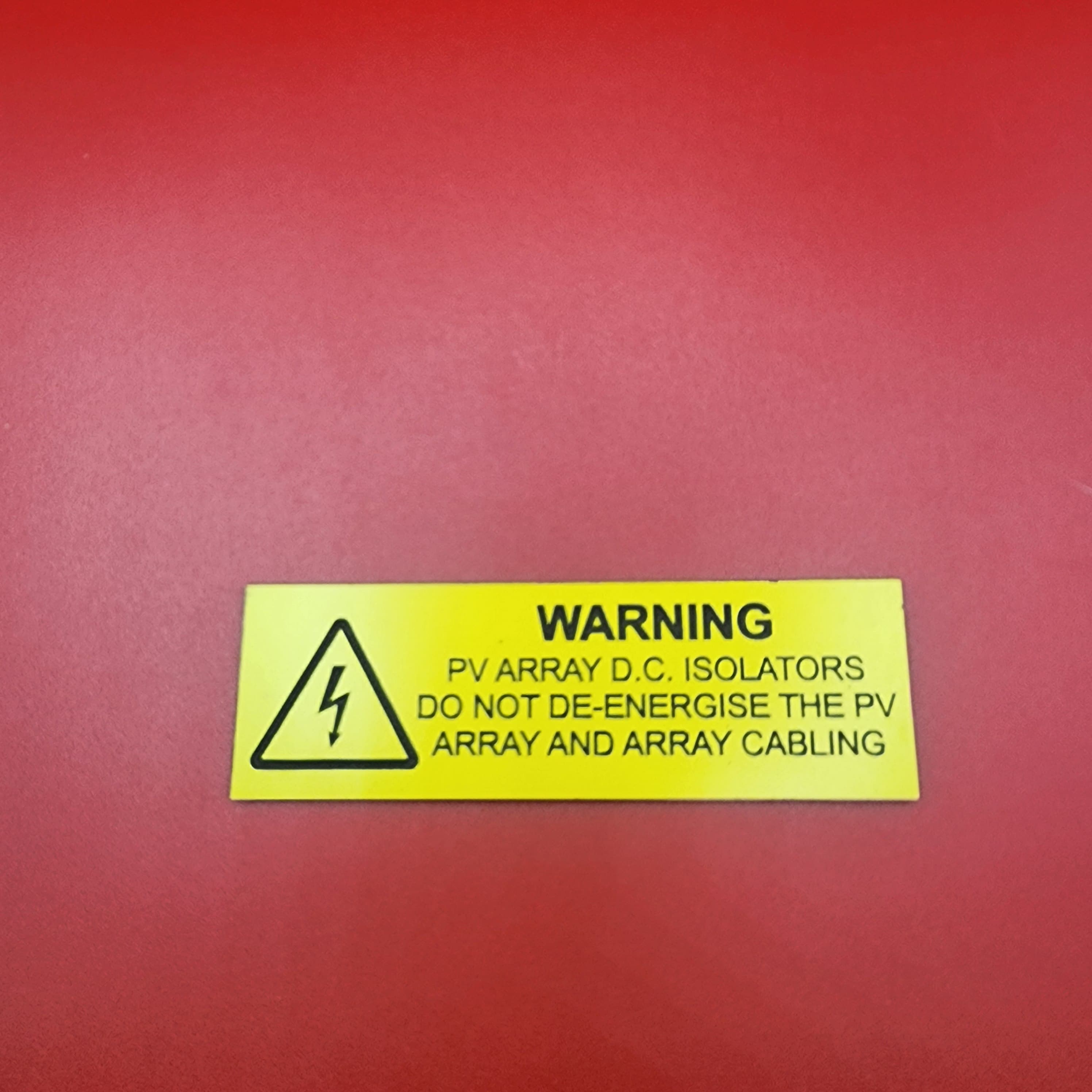
Proper switchboard labelling isn't optional in Australia — it's a legal requirement under AS/NZS 3000 (the Wiring Rules). If you're an electrician, contractor, or facilities manager, understanding these requirements helps you stay compliant and ensures that anyone working on or near the switchboard can do so safely.
This guide breaks down what needs to be labelled, how permanent the labels must be, the most common compliance issues inspectors find, and how to get it right the first time.
Why Switchboard Labelling Matters
Switchboard labels serve a critical safety function. In an emergency — a fault, a fire, or someone receiving an electric shock — the labels on a switchboard are often the only guide for quickly identifying and isolating the correct circuit. Unclear, missing, or incorrect labels can lead to:
- Delayed emergency response — Precious seconds lost trying to identify the right breaker.
- Incorrect isolation — Shutting down the wrong circuit, leaving a hazard energised.
- Compliance failures — Failed inspections, defect notices, and potential liability issues.
- Confusion during maintenance — Electricians working on the wrong circuit because labels are missing or illegible.
If you would rather skip to the practical end: RBZ 3D makes engraved switchboard labels that meet the permanence requirement covered below — designed online with instant pricing, no minimum order, and cut in Townsville by a licensed electrician.
What Must Be Labelled?
Circuit Identification
Every circuit breaker, RCD, and isolator in a switchboard must be clearly labelled to identify the circuit it protects. AS/NZS 3000 Clause 2.8 requires that switchboard labelling enables the identification of each circuit and the area or equipment it supplies.
Good circuit labelling includes:
- Circuit reference number — e.g., "CB1", "CB2", etc.
- Description of what it supplies — e.g., "LIGHTS — GROUND FLOOR", "GPOs — OFFICE 3", "A/C UNIT — LEVEL 2"
- Rating (recommended) — e.g., "20A", "32A"
Main Switch Identification
The main switch must be clearly identified and readily accessible. This label needs to be prominent — someone unfamiliar with the building should be able to walk up to the switchboard and immediately know which switch kills the power.
Warning Labels
AS/NZS 3000 and state regulations require specific warning labels in certain situations:
- "DANGER — HIGH VOLTAGE" — Required on any switchboard containing circuits above 230V.
- "WARNING — MULTIPLE SUPPLIES" — Required when a switchboard is fed from more than one source (e.g., mains + solar, mains + generator, dual utility feeds). This is increasingly common with solar installations.
- RCD test labels — RCDs must have a label reminding users to test them regularly (typically every 3 months for residential, monthly for commercial).
- Isolation procedure labels — Required in commercial and industrial settings under WHS regulations.
Earth and Neutral Bar Identification
Where multiple neutral or earth bars exist within a switchboard, each should be labelled to prevent cross-connection during maintenance.
Permanence Requirements
This is where many installations fall short. AS/NZS 3000 requires labels to be permanent and legible for the life of the installation. The standard specifically states that labels must be durable and not easily removed or defaced.
In practice, this means:
- Handwritten labels — Not acceptable. They fade, smudge, and become illegible over time.
- Paper labels or sticky notes — Obviously not permanent. Inspectors will flag these immediately.
- Dymo-style tape labels — A grey area. While better than handwriting, the adhesive often fails in warm environments (particularly in Queensland and the Top End), and the embossed text can be hard to read. Many inspectors won't accept them for permanent installations.
- Printed adhesive labels — Acceptable if they use UV-resistant materials, but they can peel or yellow over time in harsh conditions.
- Engraved traffolyte labels — The gold standard. Laser-engraved or rotary-engraved plastic laminate labels are permanently legible, heat-resistant, UV-stable, and won't fade, peel, or deteriorate. This is what inspectors expect to see on commercial and industrial work.
Label Material Comparison
Here is how the common label material options compare across the factors that matter for AS/NZS 3000 compliance:
| Label Type | Typical Lifespan | UV Resistant | Heat Stable | Inspector Accepted |
|---|---|---|---|---|
| Handwritten | Weeks–months | No | No | No |
| Paper / sticky note | Weeks | No | No | No |
| Dymo-style tape | 2–5 years | Partial | Partial | Grey area |
| Printed adhesive | 3–7 years | Some | Limited | Sometimes |
| Engraved traffolyte | 20+ years | Yes | Yes | Yes |
| Engraved stainless / aluminium | 30+ years | Yes | Yes | Yes |
Common Compliance Issues
Based on common inspection failures and defect notices, here are the most frequent switchboard labelling problems:
1. Missing Labels Entirely
The most basic issue — circuits with no labels at all. This is surprisingly common on older switchboards and on additions where a new circuit was added but never labelled.
2. Generic or Vague Descriptions
Labels like "SPARE", "MISC", or "OTHER" don't help anyone. Every active circuit should have a specific description that lets someone identify what will lose power when that breaker is switched off.
3. Outdated Labels
Circuits get repurposed over time, but the labels don't always get updated. A label that says "WORKSHOP GPOs" when the workshop was converted to an office five years ago creates confusion and is a compliance risk.
4. Illegible Labels
Handwritten labels that have faded, printed labels that have yellowed, or Dymo tape that's peeling off. If you can't read it clearly from a normal working distance, it doesn't meet the standard.
5. Missing Warning Labels
The "MULTIPLE SUPPLIES" warning is commonly missed on switchboards that have had solar added after the original installation. If a solar inverter feeds into the switchboard, this label is mandatory.
6. Non-English Labels
In Australia, switchboard labels must be in English. If additional languages are needed for a multilingual workforce, they can be added alongside the English text, but English must always be present.
Best Practices for Switchboard Labelling
- Use engraved traffolyte — It is the most universally accepted method and will last the life of the installation without maintenance.
- Be specific — "GPOs — KITCHEN EAST WALL" is better than "KITCHEN".
- Use a consistent format — Decide on a naming convention and stick to it across the entire board. Circuit number, then description, then rating.
- Include a circuit schedule — A laminated or engraved circuit directory inside the switchboard door is good practice and may be required in commercial settings.
- Label both sides — If the switchboard has a front and rear access, labels should be visible from the side where work is performed.
- Update labels when circuits change — Make relabelling part of your handover process for any modification work.
- Colour coding — Use red for emergency circuits, orange for essential services, and standard colours (typically white on black) for general circuits. This provides an extra visual cue during emergencies.
Switchboard Labelling Inspection Checklist
Before calling a job complete, run through this quick checklist. If every answer is yes, you are meeting the AS/NZS 3000 labelling requirements.
- Does every active circuit breaker, RCD, and isolator have a label?
- Does each label clearly identify what the circuit supplies (not just "SPARE" or "MISC")?
- Is the main switch clearly identified and visible?
- If there is solar, a generator, or multiple utility feeds — is the "MULTIPLE SUPPLIES" warning fitted?
- Are RCDs fitted with a test-reminder label?
- Are all labels in English and legible from normal working distance?
- Are the labels permanent — engraved or equivalent — and not handwritten, paper, or Dymo tape?
- Are warning labels (DANGER, HIGH VOLTAGE, HAZARD) fitted where required?
- For commercial/industrial jobs — is an isolation procedure label fitted?
- Is the circuit schedule up to date with the as-installed wiring?
Save this checklist to your phone or pin it in the van. Running through it before the final walkaround saves defect notices later.
Related Guides
- How to Label a Switchboard: Practical Guide for Australian Sparkies
- Switchboard Label Colours in Australia: AS/NZS Standards Explained
- RCD Test Labels & Labelling Requirements in Australia
- Main Switch & Isolator Labels: Australian Requirements
Ordering Switchboard Labels
You can design and order compliant switchboard labels online with our Label Designer. Choose from traffolyte in multiple colour combinations, enter your text, set your dimensions, and get instant pricing. For full switchboard labelling jobs, consider one of our plans to reduce per-label costs, or contact us for trade pricing on bulk orders.
We ship Australia-wide, and most label orders are produced within 1–3 business days.
Need the labels themselves? RBZ 3D engraves custom switchboard labels to order — designed online with instant pricing, no minimum order. New to the material? Start with traffolyte labels.
Wondering what labels cost? See real per-label traffolyte label prices for common sizes — no quote needed — or compare every Australian supplier in our where to buy traffolyte labels guide.