In an emergency, the main switch is the single most important label on a switchboard. Someone unfamiliar with the building — a first responder, a tenant, a visiting electrician — needs to walk up to the board and immediately know which switch kills the power. If that label is missing, unclear, or buried, seconds matter.
This guide covers the labelling requirements for main switches, sub-main isolators, and individual circuit isolators under AS/NZS 3000, plus practical advice for Australian electricians on what works on site.
Main Switch Identification
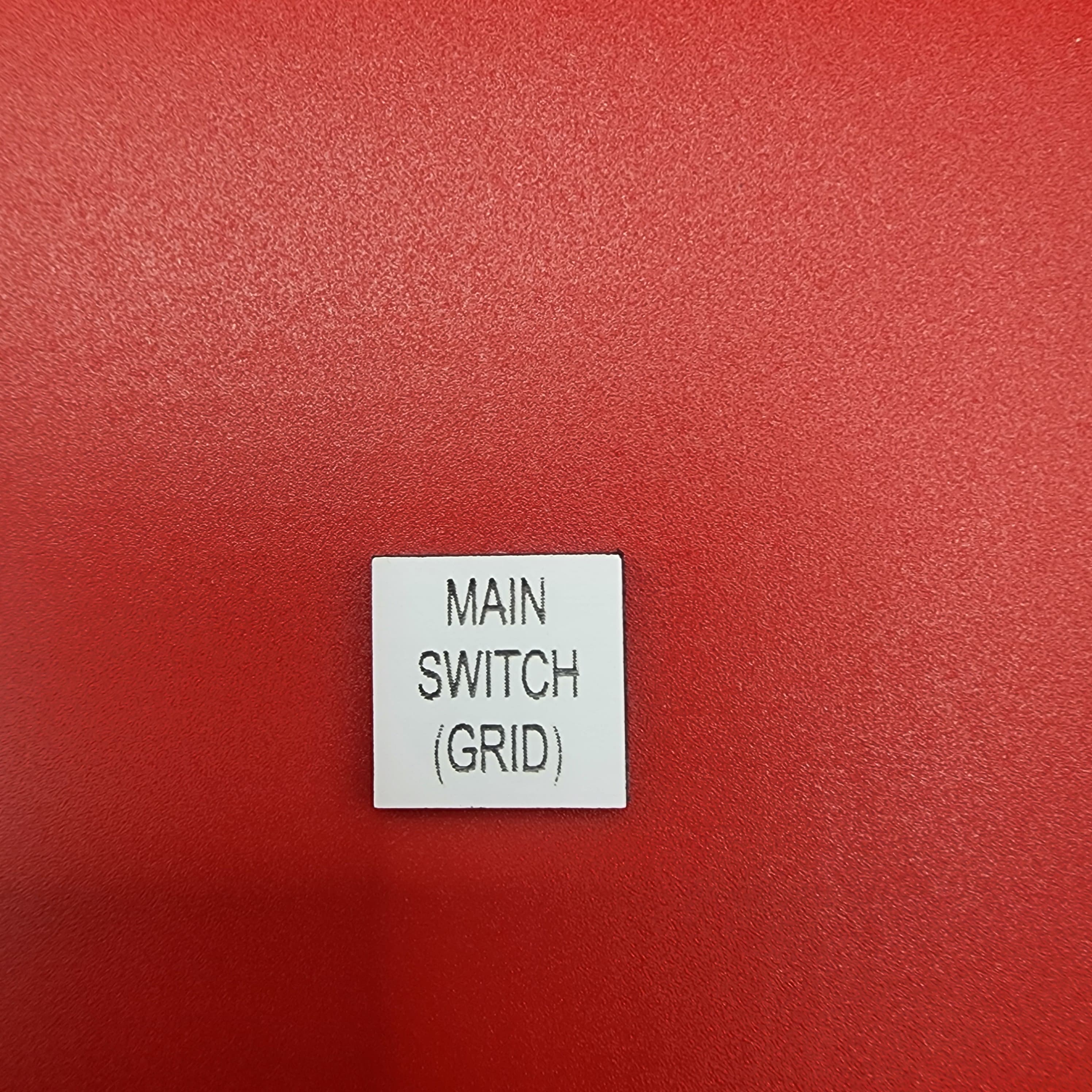
AS/NZS 3000 Clause 2.5.3 requires that the main switch be readily identifiable and accessible. In practice, that means a clear, prominent label directly above or adjacent to the switch itself.
What the Main Switch Label Should Say
The standard label is simply:
- "MAIN SWITCH" — the minimum required
- "MAIN SWITCH — ELECTRICITY" — preferred when the board has other services (gas, water)
- Colour: White text on red background for emergency visibility
- Size: Larger than circuit ID labels — typically 25–50mm high text
Multiple Main Switches
Where a board has more than one main switch — for example a dual-phase incoming supply or a separate solar isolator — each main switch must be individually labelled and the switchboard must carry an additional label indicating multiple supplies are present.
Main switch labels are one of the few an inspector checks every time. RBZ 3D engraves them to order — see main switch and switchboard label options, or design one now with instant pricing.
Multiple Supplies Warning
If the switchboard is fed from more than one source — mains plus solar, mains plus a generator, dual utility feeds, or an inverter — AS/NZS 3000 requires a warning label at the board. The standard wording:
WARNING — MULTIPLE SUPPLIES. ISOLATE ALL SOURCES BEFORE WORKING ON THIS SWITCHBOARD.
This is black text on a yellow background. For solar installations, it often includes specific reference to the PV inverter isolator location.
Sub-Main and Distribution Board Isolators
Distribution boards fed from a main switchboard need their incoming isolator labelled to show:
- It is an isolator (not a main switch, which implies no upstream supply)
- The source it can be isolated from ("SUPPLY FROM MAIN SWITCHBOARD — LEVEL 1")
- The rating of the isolator
Typical label wording: "SUB-MAIN ISOLATOR — FROM MSB"
Individual Circuit Isolators
Individual equipment isolators — such as those fitted adjacent to air conditioning units, hot water systems, or three-phase motors — need labels that identify:
- The equipment being isolated ("A/C UNIT — LEVEL 2")
- The source of supply ("SUPPLIED FROM SWITCHBOARD MSB-1, CB 14")
- Any warnings about downstream circuits
Emergency Stop and Emergency Off
Where an emergency stop is fitted (common in commercial kitchens, workshops, and machinery), the label conventions are:
- Red mushroom head physically identifies it as an emergency stop
- "EMERGENCY STOP" label in white-on-red directly adjacent
- Secondary label identifying what it stops — e.g., "EMERGENCY STOP — COOKING EQUIPMENT"
- If there are multiple E-stops, each needs its own clearly identifying label
Isolation Procedure Labels (Commercial / Industrial)
Under WHS regulations, commercial and industrial installations often require an isolation procedure label on the switchboard. This sets out the steps to safely isolate the installation for maintenance:
- Notify affected personnel
- Open the main switch
- Open all distribution isolators
- Verify dead with a tested voltage indicator
- Apply locks and tags
- Post the "DO NOT OPERATE" notice
This is typically a larger label — often A5 or A4 size — mounted inside the switchboard door or on the board itself.
Lockout / Tagout (LOTO) Integration
For switchboards used in industrial installations with regular maintenance, the main switch and any downstream isolators should be:
- Capable of being padlocked in the OFF position
- Labelled with instructions for the locked position ("LOCK OFF FOR MAINTENANCE")
- Included in the facility's lockout register
Common Mistakes with Main Switch Labelling
Label Too Small
A 10mm-high "MAIN SWITCH" label gets lost among 5mm circuit labels. Make it bigger.
Label Not Visible When Cover Open
If the main switch label is on the removable cover and the cover is off during an emergency, the label is gone. Mount main switch labels on the fixed panel or directly on the DIN rail cover.
Assuming "Main Switch" Is Obvious
For electricians it is obvious. For a building occupant seeing a row of ten identical-looking switches, it's not. Label it clearly.
Ignoring Secondary Supplies
Solar installations are the most common. Flicking the main switch doesn't kill the power if the inverter is still feeding the board. The "MULTIPLE SUPPLIES" warning is mandatory, not optional.
Missing Isolator Labels on Equipment
HVAC units, hot water, and three-phase motor isolators are frequently installed without identification labels. If someone needs to isolate the unit from outside the main board, they need to know they are looking at the right isolator.
Main Switch Label Size and Placement
Rule of thumb for residential and light commercial boards:
- Main switch label: 80mm × 25mm or larger, white on red
- Placement: Directly above or immediately adjacent to the switch handle
- Visible when cover is open — not just on the face
For larger switchboards, scale the label up so it's readable from a normal working distance (2–3 metres).
Related Guides
- Switchboard Labelling Requirements in Australia: AS/NZS 3000 Explained
- Switchboard Label Colours in Australia: AS/NZS Standards Explained
- RCD Test Labels & Labelling Requirements in Australia
Ordering Main Switch and Isolator Labels
Our Label Designer has common main switch and isolator templates pre-loaded — start with one and edit, or design from scratch. Engraved traffolyte in white-on-red is our most popular combination for main switch labels. Contact us for bulk orders or trade pricing.
Ordering the labels? We engrave main switch and circuit breaker labels to order, plus complete switchboard label sets — instant online pricing, no minimum.